

Traditional Automation: The reliable workhorse
Think of traditional automation as your dependable employee who follows the exact same process every single time. You give it clear instructions, and it executes them perfectly. No questions asked, no deviations.
Here's how it works:
If A happens, do B. Always. No matter what.
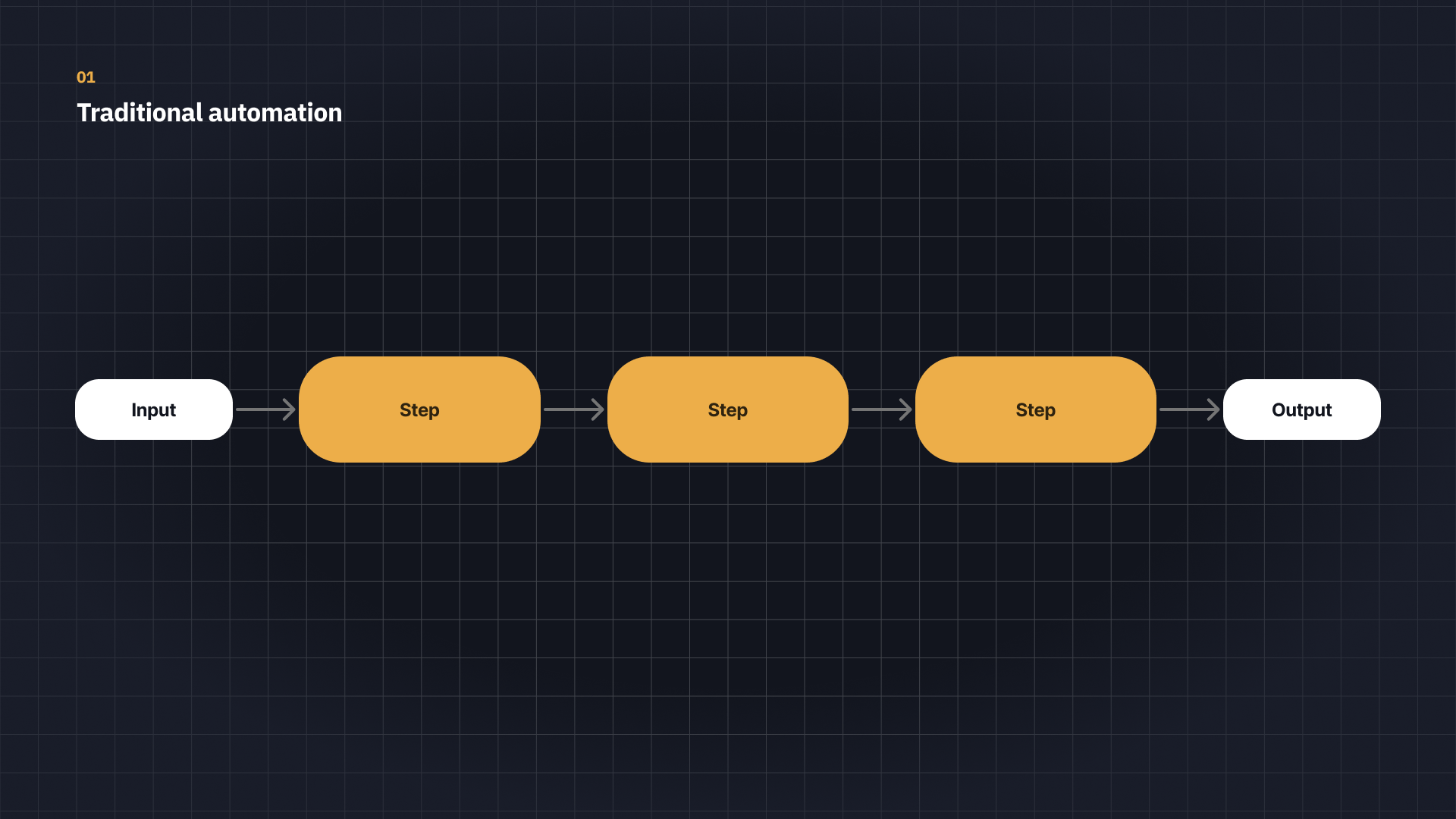
As you can see in the diagram above, traditional automation follows a straight line from input to output. Every step happens in the same order, every single time.
Take our work with Hillewaere Verzekeringen, for example. Insurance brokers needed to manage fleet insurance policies across multiple offices, each with slightly different workflows. We built a platform that automates policy tracking, renewal notifications, and certificate generation. Same steps, same sequence, every time. The result? Tasks that used to take hours now complete in minutes.
When to use traditional automation:
- The process is consistent
- You need it done the same way every time
- Speed and reliability matter most
The catch? Traditional automation can't handle anything outside its predetermined rules. If something unexpected happens, it either breaks or produces errors. That's where things get interesting.
Agentic Automation: The smart orchestrator
Now imagine giving your automation a bit of intelligence. Instead of following a rigid script, it can look at the situation and decide which path to take.
Here's the key difference:
The AI chooses which tools to use and in what order, based on the context of your input.
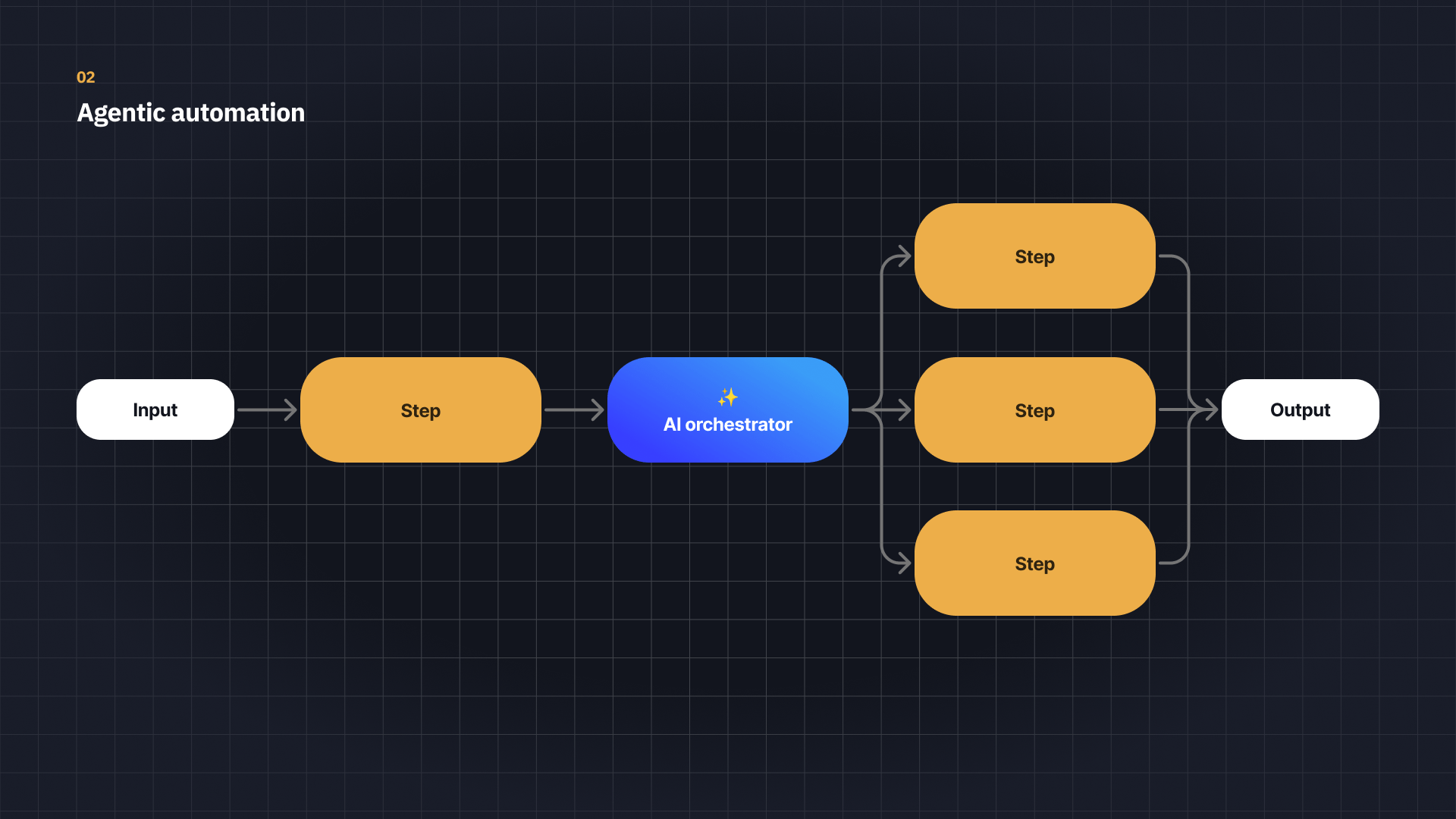
Notice how the workflow now branches? The AI orchestrator sits in the middle and decides which steps to execute based on what it sees. Same input, but potentially different paths to the output.
Our work with Van Gils is a perfect example. When ice cream orders arrive via email, the system doesn't just blindly process them. It reads the purchase order, identifies whether it's a standard order or a complex one with special requirements, and routes it accordingly. Simple orders? Quick extraction and immediate entry into the ERP. Complex orders with custom requests? Additional validation steps and potential human review.
Same goal (process the order) but different routes depending on what's actually needed. This intelligent routing reduced manual order processing by 80%.
When to use agentic automation:
- Your process has multiple valid paths
- Context matters for decision-making
- You need smart routing based on input
- You want flexibility within defined boundaries
The important thing to understand: agentic automation still works within the toolkit you've defined. It's like giving someone a toolbox and saying, "Use whatever makes sense for this job." They can't go buy new tools, but they can choose the right ones for the situation.
Agents: The autonomous problem-solver
Here's where things get really interesting. An agent doesn't just follow a workflow or choose between predefined paths. It actively pursues goals.
The game-changer:
Agents can perceive their environment, make decisions, take actions, learn from results, and adapt their approach completely.
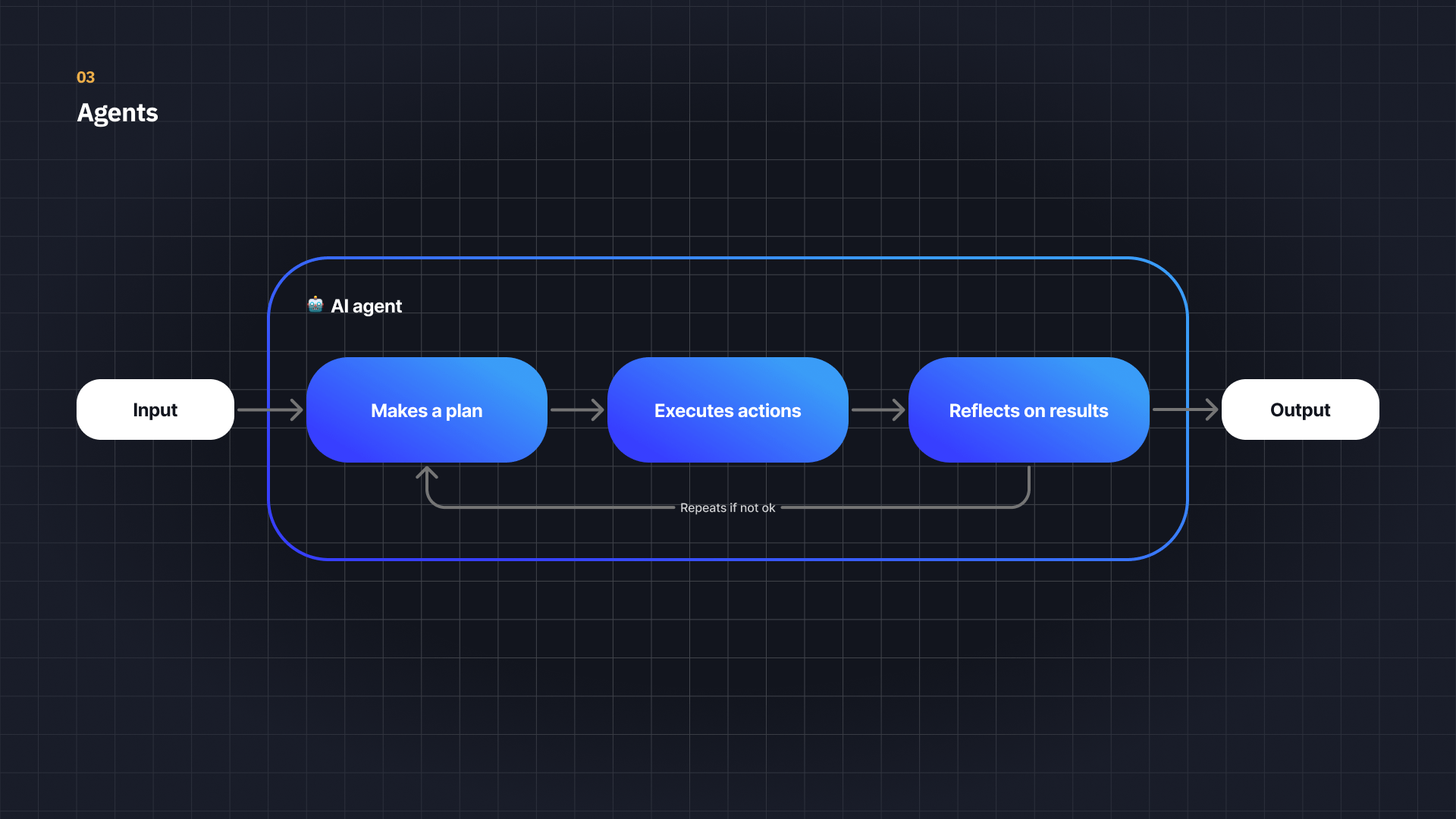
The diagram above shows the key difference: agents work in a continuous loop. They make a plan, execute actions, reflect on the results, and if things aren't right, they go back and try again. This cycle continues until the goal is achieved.
Imagine a customer service agent (the AI kind). A customer asks a complex question about pricing for a bulk order. The agent:
- Searches the knowledge base
- Realizes it needs access to the pricing database
- Requests and receives that access
- Finds related cases from past tickets
- Crafts a personalized response
- Learns from the customer's feedback for next time
Notice what happened? The agent identified what it needed, got it, and adjusted its approach on the fly. That's autonomy.
When to use agents:
- Problems are complex and context-dependent
- You need continuous learning and improvement
- Standard workflows are too rigid
- The solution path isn't always clear upfront
The trade-off? Agents require more oversight and governance. With great autonomy comes great responsibility (and the need for guardrails).
So which one do you actually need?
Here's the truth: most businesses don't need just one. They need a mix of all three.
Use traditional automation for your repetitive, high-volume tasks where consistency is king. Think data entry, report generation, or routine notifications.
Use agentic automation when you need smart routing and decision-making within known processes. Perfect for document processing, customer inquiries, or workflow orchestration where context matters.
Use agents when you're solving complex, novel problems that require adaptive thinking. Great for research tasks, strategic analysis, or scenarios where the path forward isn't always clear.
At Sixth Generation, we've built solutions across this entire spectrum. Sometimes a simple automation is exactly what you need. Other times, the situation calls for the full power of an autonomous agent. The key is understanding your specific challenge and choosing the right tool for the job.


