
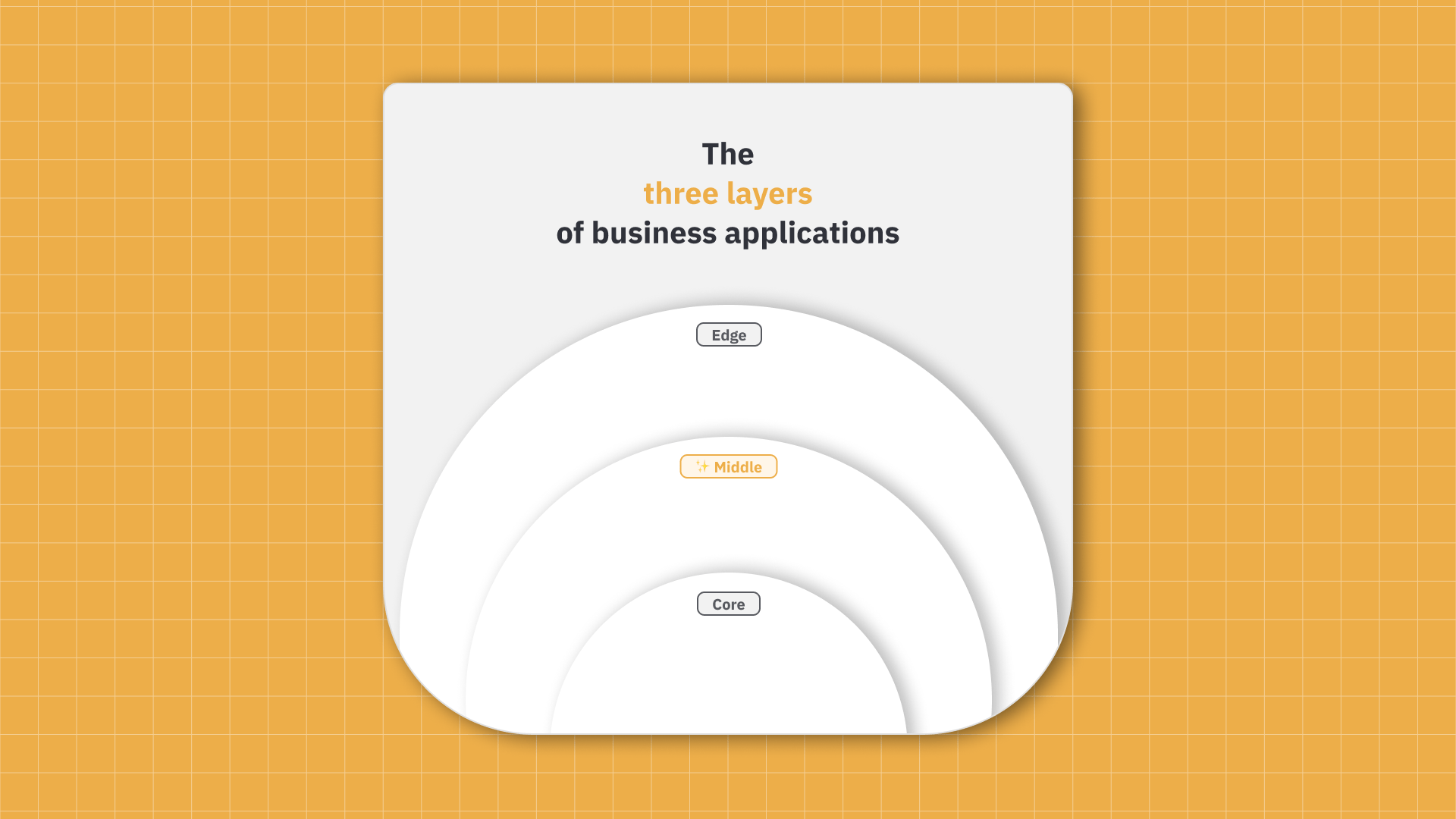
The core layer: your systems of record
The core layer is the backbone: business-critical systems of record like ERP and CRM. They hold the authoritative version of your data, including orders, inventory, customers, and invoices, and they enforce the rules and processes the rest of the business depends on.
These systems are built to be stable, comprehensive, and reliable. That's exactly what you want at the core. It's also why they're not the right tool for every job. They're designed to record reality, not to be the most pleasant interface for capturing it in the moment it happens, whether on a loading dock, in a customer call, or on the shop floor.
The edge layer: quick tools for specific needs
At the other end of the stack sits the edge: light tools that people pick up to solve the problem in front of them right now. A spreadsheet to track this week's deliveries. A shared document to coordinate a launch. Increasingly, an AI chatbot to draft, summarise, or look something up.
The edge layer is fast, flexible, and close to the user. That's its strength. The downside is that it lives outside your systems of record. Data gets duplicated, decisions are made on a version someone forgot to refresh, and when the spreadsheet's owner leaves, the process leaves with them.
.png)
The smart middle layer: where core meets reality
In between sits the layer most companies under-invest in: the smart middle layer.
This is where you build applications that sit on top of your core systems and turn them into something operational teams actually want to use. Back-office apps that automate a process end-to-end. Workflow automation that quietly moves data between tools. AI agents that handle the repetitive judgement calls. These applications don't replace your ERP or CRM; they translate them.
The middle layer earns its keep in two directions.
It makes the core layer operational. Instead of asking a warehouse team to navigate seven screens of an ERP to record a single check, you give them a clean, purpose-built interface that writes the same data back. The core stays the source of truth; the work happens somewhere the user can actually do it quickly.
It also rescues things from the edge layer. The spreadsheet that grew into the planning tool the whole team depends on, or the workaround that quietly became load-bearing, can be lifted out of the edge and rebuilt as proper applications that integrate with the rest of your IT landscape. You keep what made the spreadsheet useful: the logic, the ownership, the speed of iteration. You lose what made it fragile: no audit trail, no integration, no path to scale.
Done well, the smart middle layer is where the messy reality of how work happens finally meets the structured reality your core systems insist on. Neither side has to compromise.
Improve the way you work
You don't need to replace your core systems, and you don't need to ban spreadsheets. Both layers exist for good reasons. What most organisations are missing is the middle: a deliberate layer of applications that connects the systems of record to how work actually happens.
That's where the biggest, fastest wins usually sit. Build the smart middle layer well, and the core becomes more useful, the edge becomes less risky, and the people doing the work finally get tools that fit how they work.


